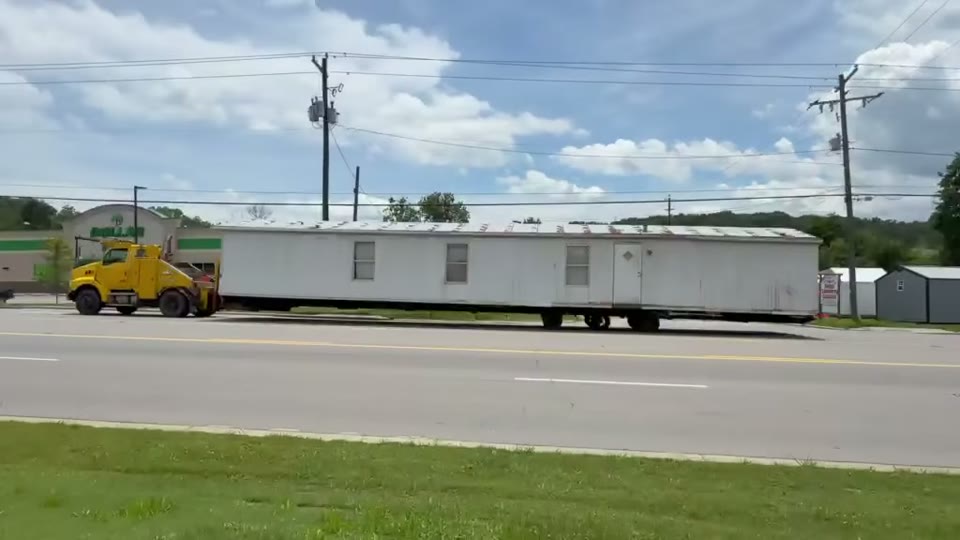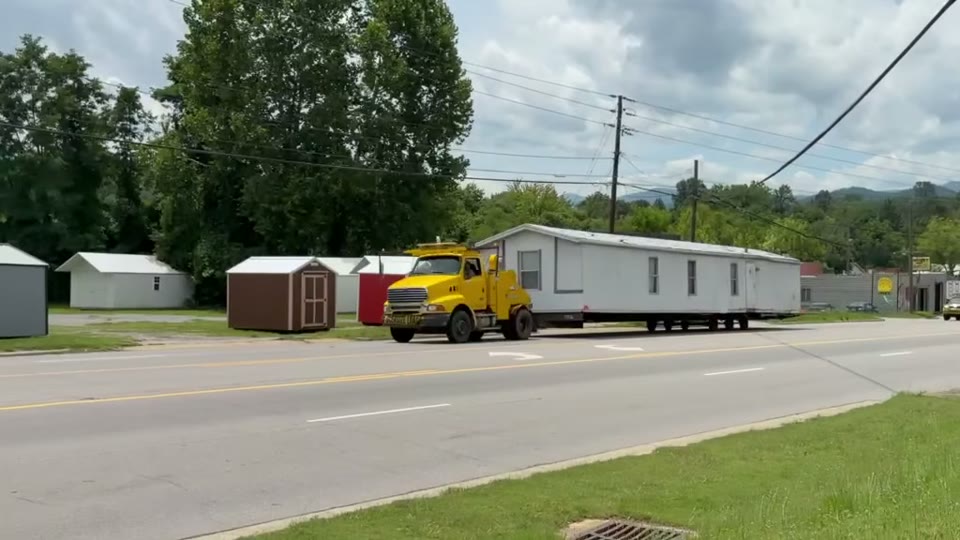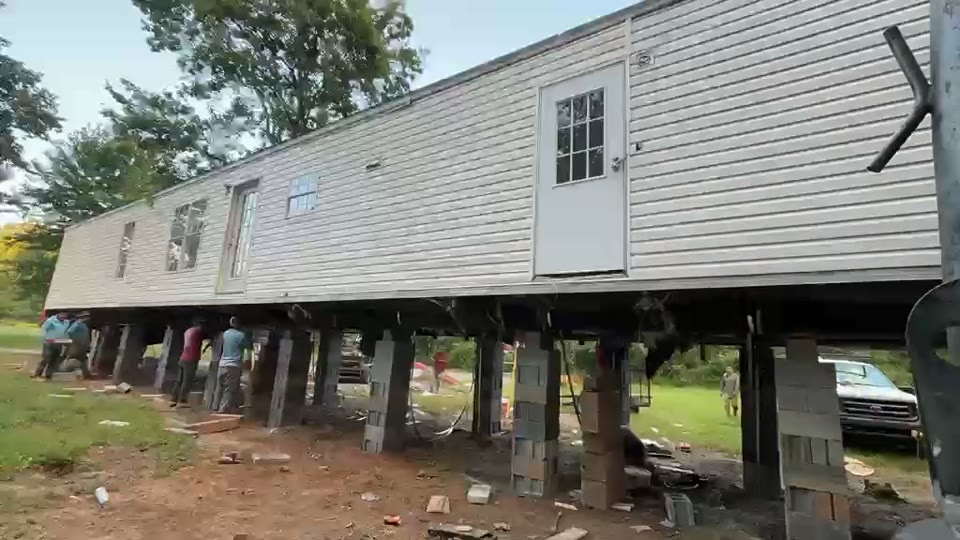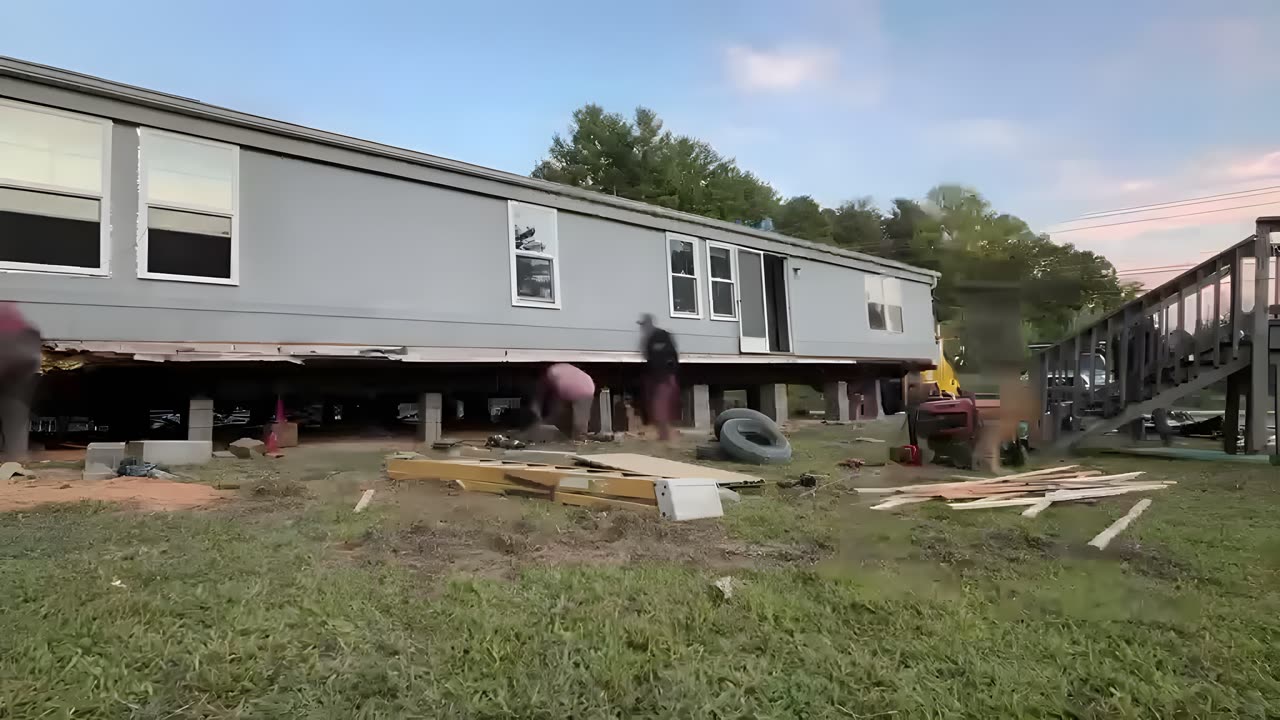
After the haul: what the installation work actually is
Black Mountain sits at the eastern edge of Buncombe County, where the Blue Ridge foothills break into ridgelines, creek-bottom flats, and steep cove lots. That topography shapes every manufactured home installation in town. A level lot off a flat road needs a straightforward pier layout. A ridgeline site with a cross-slope needs stepped blocking under the perimeter and possibly additional center-beam support to compensate for grade. No two lots read the same before the first pier goes in.
The sequence once the home is positioned on the lot: concrete pads and perimeter piers are set per the manufacturer's specifications, center-beam piers are added at the required spacing, and the home is shimmed and leveled at each bearing point. This work is governed by the home's HUD data plate and the NC Manufactured Housing Board installation requirements. Over-the-top straps and ground anchors are then installed and tensioned. Utility connections follow. Skirting closes the perimeter last, and a county or town inspector signs off before the home is occupied.
If any stage in that sequence is unfamiliar, the manufactured home setup guide walks through each one in detail.
What a Black Mountain set costs
The full county-wide breakdown is at the NC manufactured home installation cost page. The table below shows how scope maps to price for work done around Black Mountain, using typical market ranges for labor and materials. These are not quotes and do not include the home itself or any lot grading done before placement.
| Work scope | Typical market range |
|---|---|
| Single-wide set — piers, pads, blocking, leveling, anchoring | $1,500 – $3,000 |
| Double-wide set — piers, pads, blocking, leveling, marriage-wall support, anchoring | $3,000 – $6,000 |
| Skirting — vinyl, standard perimeter | $800 – $2,000 |
| Utility hook-ups — water, sewer, electric service | Site-specific; priced separately |
Steep or limited-access sites and ridge-top lots with extra pier requirements typically push a job toward the upper end of its range rather than below it. Any quote for a Black Mountain lot that arrives without a prior site visit hasn't accounted for the lot yet — treat it as an opening estimate, not a firm number.
Permits: inside and outside Black Mountain town limits
Black Mountain incorporates its own town limits, which means permit jurisdiction depends on where the lot sits. Inside Black Mountain's limits, the town handles the manufactured home installation permit. Outside town limits but still in Buncombe County, the permit runs through Buncombe County Permits and Inspections in Asheville NC. Both offices require the same core documentation: the home's HUD data plate and manufacturer's installation manual, proof of water service — a utility letter or meter receipt for public water, or a county well authorization for a private well — and proof of wastewater service, either a Metropolitan Sewerage District approval inside their service territory or a county septic authorization outside it.
If the home is relocating from another county, a tax-paid moving permit is required before the home can leave its current site, under NCGS Chapter 105, Article 18. For the oversize-load transport permit covering the haul itself, the NCDOT MH-2 publication covers route requirements, timing restrictions, and what documentation travels with the load. Both permits are resolved before installation work begins, not during it.
Anchoring in a county with a storm record
Buncombe County falls in HUD Wind Zone I under 24 CFR 3280.305, the federal standard that sets minimum anchor capacity and tie-down spacing for manufactured homes. Wind Zone I is the baseline classification, and the county's federal disaster history makes meeting it precisely a practical matter, not just a code formality.
19 federally declared incidents touch Buncombe County over 1973-2026, including hurricanes in 2020, 2021, and 2023, a tropical storm in 2024, and a winter storm in 2026. A manufactured home on a Black Mountain cove lot that hasn't been properly strapped and anchored carries a different risk profile than one set on a sheltered flat site. Anchor count, strap type, and placement spacing all derive from the installation manual for that specific home's HUD data plate — not from a generic chart. The inspector who signs off on the set is confirming this work, not just the pier count.
The governing federal framework is maintained by the HUD Office of Manufactured Housing Programs.
Utilities and hook-ups: what sequences after the set
Utility connections are made after the home is set and leveled but before final inspection. Electric service is coordinated with the serving utility; the home's electrical system passes as part of the installation inspection. In older Black Mountain neighborhoods, the service entrance may need upgrading before the home can connect — scope that separately before the home arrives, not after it does.
Water and wastewater documentation goes into the permit application before a permit issues. MSD approval or county septic authorization for wastewater, and a utility letter or well authorization for water, are required upfront. Sites where the utility stub sits farther from the home's planned position cost more to connect, which means lot-placement decisions directly affect hook-up cost. Those decisions are easiest to adjust before the home is delivered.
The Black Mountain leveling page covers site preparation and grading that happens before placement.
Hiring a crew for a Black Mountain installation
Three questions worth putting to any installer before work begins: Have they pulled permits with Buncombe County Permits and Inspections or with the town of Black Mountain? Do they carry general liability and workers' compensation insurance, and will they hand over a certificate before work starts? And do they sequence the inspection correctly — keeping work the inspector needs to verify accessible before the first sign-off, finishing the rest after?
That third question separates installers who understand the local process from those who guess at it. A set called back because the inspector couldn't access a bearing point or verify an anchor costs time and usually money the homeowner ends up absorbing. Installer licensing in North Carolina runs through the NC Manufactured Housing Board. Checking your installer's license status before work starts is straightforward and worth doing.