Slopes, rentals, and what Sylva re-leveling actually costs
Cullowhee's student rentals flip between tenants every August, and the hills along US-23/74 don't rest between leases. By the time a tenant reports a bouncing floor or a door that won't close, the home has usually been out of level for at least a season.
Mobile home leveling in Sylva NC is a regular cost of ownership on Jackson County's steep terrain. Re-leveling a single-wide typically runs $400 to $1,200; a double-wide runs $700 to $2,000. Those ranges hold when the piers and pads are structurally sound. When a pier has cracked, sunk, or rotted out after one of the county's storm seasons, replacing it pushes the full job toward $2,500 to $5,000. See the re-leveling process page for what drives cost in mountain county work.
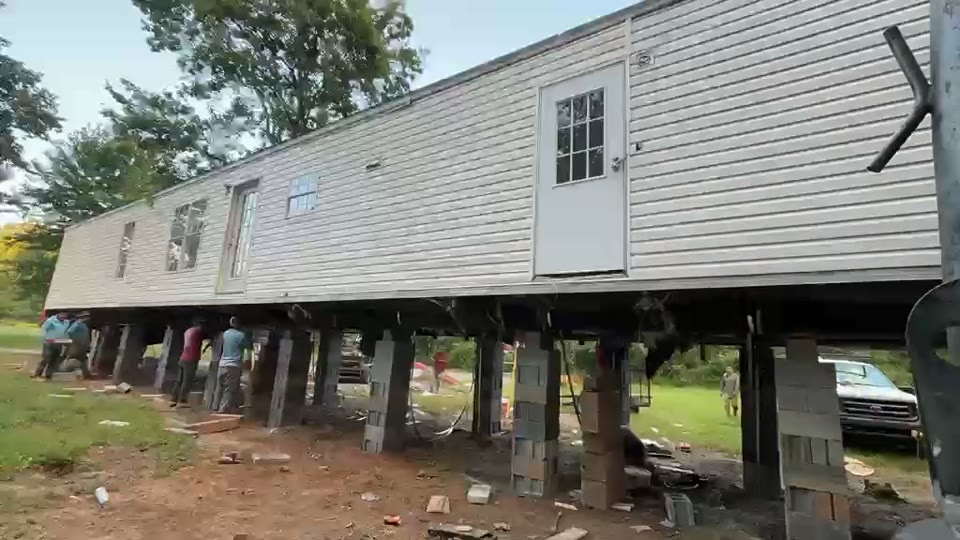
Most Sylva-area homes sit on concrete block piers over poured pads, often on ground that was cut and backfilled to create a level pad site on a hillside. That fill settles unevenly, the piers shift, and the home follows. It is the terrain, not a defect in the home.
Signs worth acting on before the problem compounds
The early signs show up in doors and floors. A door that closed fine last year and now binds on the latch side, but not at the top or bottom, is racking: the frame is no longer square. Diagonal cracks at window and door corners confirm the same thing. A floor that bounces when you walk over a pier location means the pier-to-floor contact has loosened or the pier has leaned. In Jackson County's hollow lots, the first sign is often more gradual — soil under the pads has softened after a wet season, and the home has been settling slowly ever since.
Less obvious but just as telling: a gap opening at the wall-to-ceiling joint at one end of the home, or a seam in the floor covering that has widened along a pier line. Both trace to the frame flexing around a low corner.
Movement that loosens and tightens with seasons almost always traces to moisture cycling at wood blocking or pads. Movement that only grows, regardless of season, means a pad or pier has failed and needs replacement, not just a reset. Catching the second kind early keeps the job in the lower half of the cost table rather than the upper.
What the work actually involves
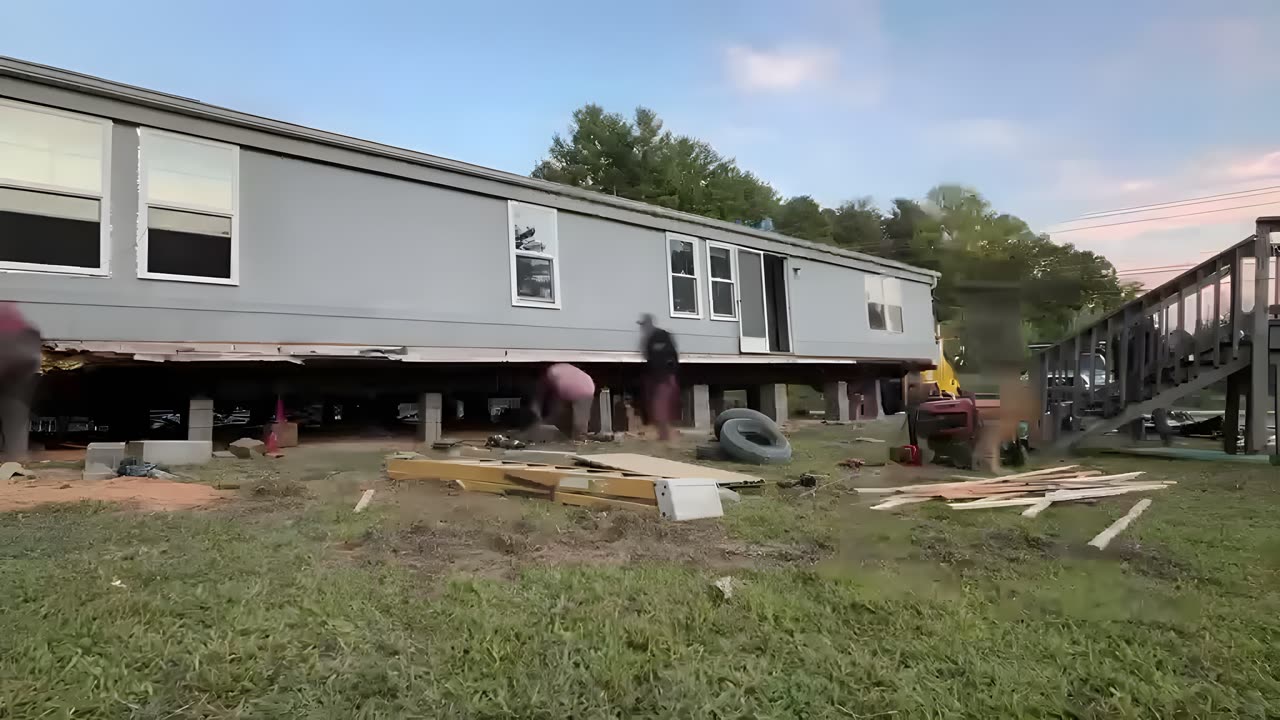
Re-leveling starts with a crawl-space inspection: which piers are carrying load, which have shifted, and whether any pads have tipped or crumbled. Hydraulic jacks raise each low section incrementally, never more than a fraction of an inch at a time, to avoid stressing the frame. Once the floor plane is back within tolerance, the pier stacks are shimmed, the blocking is reset, and anything that failed is replaced.
On slope lots above Sylva or behind the ridge lines toward Cullowhee, access under the home can be tighter than on flat ground, and uphill piers are often carrying more load because the home has been weighted toward them. That affects both job time and the likelihood of finding a pier that needs full replacement rather than shimming.
When the work goes beyond shimming and blocking, such as resetting the marriage wall connection on a double-wide or correcting overall chassis alignment, it crosses into territory governed by full setup and installation standards, which sets a different scope and cost floor.
Typical costs across common Jackson County scopes
The table below covers the most common re-leveling jobs in this market. All figures are typical ranges; slope, tree clearance, and pier count each move the final number. Homes on hollow lots around Cullowhee may also face limited under-home clearance, which adds hand-digging time to any pier work.
| Scope | Typical Range |
|---|---|
| Single-wide, piers and pads sound — shimming and re-level only | $400 – $800 |
| Single-wide, full re-level with blocking and pad reset | $800 – $1,200 |
| Double-wide, piers and pads sound — shimming and re-level only | $700 – $1,200 |
| Double-wide, full re-level with blocking reset | $1,200 – $2,000 |
| Either size, with failed pier or pad replacement | $2,500 – $5,000 |
Work requiring a complete perimeter reset or new anchor installation carries cost above the ranges shown. For the statewide picture with footnotes on what drives each line item, see mobile home leveling cost in NC.
Storm history and what it means for anchoring
Jackson County falls within HUD Wind Zone I under 24 CFR 3280.305, the baseline wind design zone. It applies to both anchoring hardware requirements and the installation geometry the original setup was built to meet. When a home is re-leveled after a storm season, a visual inspection of the ground anchors and tie-down straps should be part of the job, not an afterthought. The same events that knocked the home out of level have likely stressed the anchor system in ways that are not visible from outside.
This county has seen 17 federally declared disasters across 1973-2026, including a 2026 winter storm, a 2024 tropical storm, and hurricanes in 2023, 2021, and 2020. The National Weather Service severe weather guidance for mobile homes is unambiguous on tie-downs: they are life-safety equipment, not optional, and their condition should be verified any time the home is worked on at the foundation level.
What to ask before the job starts
Three questions separate a thorough re-leveling contractor from one who jacks the floor and leaves.
First: do they inspect the pads and blocking, or only check the floor plane? A re-level that restores floor level without confirming what the piers are sitting on is temporary. The pad and anchor condition should come back in a written or verbal scope report before work begins.
Second: are they registered with the NC Manufactured Housing Board? The Board oversees licensing for contractors doing manufactured housing installation and setup work in North Carolina, with rules that sit on top of the federal HUD installation standard. Any job that triggers an installation permit should involve a licensed party.
Third: what happens if they find a failed pier mid-job? Get the number for both scenarios (piers sound, and piers failed) before work starts, not after. For homes that changed sites recently, the NCDOT oversize permit framework covered in Publication MH-2 governs the transport phase and affects how initial anchoring is configured.